Mar 10, 2013

D-Link DIR-615 DD-WRT Firmware Flashing


Here I want to share an example of a D-Link DIR-615 how to flash the popular alternative DD-WRT router firmware. Basically, you should bring some experience in dealing with firmware updates. One of the golden rules: If you are not absolutely sure of what you're doing, leave it! I extended countless router with DD-WRT. Rarely there are problems. To destruction, it is not gone too! Check out the tutorial at your leisure. If you need help at some point, just let me know.


First, we determine if the existing model is at all compatible. In this case it is a D-Link DIR-615 router. We get the best data on the nameplate: Important here is the hardware version.


By knowing the hardware version of the D-Link DIR-615  we may now proceed to DD-Wrt database router and enter the last three characters of our model.


Here we must take special care to choose the correct hardware version! An incorrect version can possibly transform the barely functioning router into a paperweight 1A, inshort we may bricked the device by loading the improper firmware to D-Link DIR-615 !


There is a special version (initial flashing) for flashing the DD-Wrt firmware. If there is such a version for your model, choose the smallest existing version (size) of the DD-Wrt firmware. Save the file, and then we go. Open the web interface of your router. In the model shown here, D-Link, select the item maintenance / firmware update.


Next, "Select file" to the point, we open the saved firmware file.


Then, Select the previously saved firmware file and press Open.


By clicking "Upload" the flash starts. During the flash process, you should leave the router alone. Connect. Example to any network cables or pull out what


You see, as long as the flash process is running, a status page.


During Falshvorgangs not the current should be separated! This could mean the demise of the router.

After the end of the flash process, there is a error message in the browser. The dd-wrt firmware used in the standard configuration a different IP range.


Now we can use the router by entering the default DD-Wrt IP address http://192.168.1.1. We are asked to change the user name and password. In this example, the username "admin" and "+? / M3in-75" the password (without the ""). Then click on "Change Password".

TMnet D-Link DIR-615 Username Password

The default username/password combinations for TMnet DIR-615 routers between firmware versions 7.01 to 7.05b are :


Username : admin
Password :             ( you can not see because there is no password at all )

Username : admin
Password : telekom
However, there is also a secondary account which must have its password changed in order to fully secure your network :

Username : operator
Password : telekom

Username : operator
Password : h566UniFi

Username : operator
Password : (your Unifi username in reverse order)

Firmware 7.12 and above :

Username : Management
Password : TestingR2


Download TMnet D-Link version 7.15 firmware here

config.bin reader/editor

This is small tool which can convert config.bin format used in ArmA to human readable config.cpp. It has been tested extensively with Xbox version which should use same config.bin format but until amazon.de delivers my own ArmA, I can't guarantee ArmA will accept resulting files - they look valid to me however.


Download from FTP #1: ArmA UnBIN tool          Download from FTP #2: ArmA UnBIN tool

Mod writers might find this tool useful to take a sneak peek at config file structure since there is no official commented config out yet. I know there are few tools that can open ArmA config.bin out already, but this one comes with full source code for those that might want to customize it to their needs.  Update; an alternative tool to config-explorer it Laza you can get it from mediafire here.

D-Link DIR-615 Snap Review

The DIR-615 looks very similar to the router bundled in the DKT-810 kit, except that this model works with cable Internet connections rather than ADSL, and the router only has two antennas.


Fortunately, it uses the same friendly CD-based setup wizard, so it's quick and painless to get your Internet connection working and a secure wireless network up and running.

D-Link DIR-615 Specification here  User Manual pdf

The web-based management tool is the same, too. This looks great, but some of the more advanced options, such as QoS, are tricky and a little confusing to set up correctly.

Performance using our Centrino laptop was very good. Throughput of 20.14Mbit/sec at one metre from the router was very quick, and 11.74Mbit/sec at 25 metres indicated that range wasn't a problem. You should be able to get good reception anywhere inside the average home.

Switching to the same-brand DWA-410 USB adaptor (around £38) was disappointing, though. At one metre we managed 46Mbit/sec, which is great, but we couldn't get a signal at 25 metres, no matter how many settings we tweaked manually.

While Draft-n performance wasn't as good as we'd hoped, this router is fine if you just want to share an Internet connection wirelessly with your Centrino laptop. If you're looking for fast file sharing or video streaming, Buffalo's Nfiniti is a better choice.

D-Link DIR-615 Default Username Password

The DIR-615 looks very similar to the router bundled in the DKT-810 kit, except that this model works with cable Internet connections rather than ADSL, and the router only has two antennas.


Default router settings
IP: 192.168.0.1
Username: "admin"
Password: " " (leave the field blank)

Fortunately, it uses the same friendly CD-based setup wizard, so it's quick and painless to get your Internet connection working and a secure wireless network up and running.

The web-based management tool is the same, too. This looks great, but some of the more advanced options, such as QoS, are tricky and a little confusing to set up correctly.

Performance using our Centrino laptop was very good. Throughput of 20.14Mbit/sec at one metre from the router was very quick, and 11.74Mbit/sec at 25 metres indicated that range wasn't a problem. You should be able to get good reception anywhere inside the average home.

Switching to the same-brand DWA-410 USB adaptor (around £38) was disappointing, though. At one metre we managed 46Mbit/sec, which is great, but we couldn't get a signal at 25 metres, no matter how many settings we tweaked manually.

While Draft-n performance wasn't as good as we'd hoped, this router is fine if you just want to share an Internet connection wirelessly with your Centrino laptop. If you're looking for fast file sharing or video streaming, Buffalo's Nfiniti is a better choice.

Mar 9, 2013

Asean all quiet on the Sabah Issue

Amid the spiraling chaos in Lahad Datu, Sabah, a crucial question has been raised which no one has yet explored: What can the Association of Southeast Asian Nations do? The answer is, put plainly and simply, nothing.


Asean is an intergovernmental organization. It emerged in the era of decolonization and postwar politics and was hence a pact among newly minted states who wanted to distance themselves from their colonial masters and build their nations in conditions of peace and stability. They fought hard to negotiate their borders between old imperial demarcations, ancient community kinships, and the strategic interests of emerging national elites.

The conflict before us today is ostensibly between Malaysia (a state) and Sultan Jamalul Kiram III of Sulu (a legal person). The former has effective sovereign control over a territory whose ownership is claimed by the latter. The fact that the incredible amount of P77,000 (said to be its annual “rent” money since 1878, or cession price, depending on who interprets the concept of “pajak”) goes to the sultan and his family and not to the Philippine government, methinks, uncovers the parties who are in direct discord.

Asean compelled its member-states to promise to renounce “threat or the use of force” with the adoption and ratification of the Treaty of Amity and Cooperation of 1976. This contract was succeeded by the Asean Charter in 2008, which effectively gave the regional bloc legal personality and provided its members with the rules under which they can “resolve peacefully all disputes in a timely manner through dialogue, consultation and negotiation.” It is essential to note, however, that, in the event of a crisis, it is the member-states themselves who must be the parties in dispute (Chapter VII, Article 23). Now the heavy-handed manner with which Malacañang has warned Sultan Kiram and his followers, who are presently held captives in Sabah, seems to suggest that Prime Minister Najib Razak and President Aquino stand their countries on the same side of the thin red line.

Furthermore, in case a scenario of conflict does arise, it is also the member-states who must agree to a resolution. And here we encounter another problem: Any settlement will have to be left to the good intentions of the parties. Asean has no institutional device for enforcing decisions. If the articles on the settlement of disputes between member-states are half-baked, the institutional resolution of clashes between the distinct entities outlined above will still be a long time coming.

Do the present circumstances, however, exonerate Asean from all duty or action on the escalating conflict? No. I believe there is another way to phrase the initial question if we want to be more helpful (and hopeful): What can the member-states do for Asean?

There are three factors for the leaders to ponder.

First, Sultan Kiram has deployed his small but loyal following to reclaim what they hold to be their ancestral homeland. The move is charged with profound symbolism both for them and our Muslim brothers and sisters in the South and will reverberate long into history, especially when lives have been sacrificed. The sultan has himself admitted: “I am the poorest sultan in the world.” This is not just about fair economic compensation; it is also an appeal to clarify what his title means to him and his people in the context of present geopolitical realities.

Second, Sabah is the second largest federal state of Malaysia after Sarawak. It is home to rare fauna and flora, tracts of timberland, and palm oil plantations—a beautiful place, I am told, but it is ironically also one of the poorest regions in Malaysia. This is why it made sense for President

Fidel Ramos to push for the East Asian Growth Area (EAGA) in the 1990s, so that it may spur an “economic corridor” among Brunei, Indonesia, Malaysia and the Philippines (BIMP). The sociopolitical and economic costs for Prime Minister Najib are far too high for him to run away from this crisis, tail between his legs, like his detractors might wish.

Third, the Philippine claim to Sabah has not been “dormant”—it has been, in fact, erratic, subject to the vagaries of domestic and international politics, more than what should have been from the start a clear, consistent and firm conviction of Filipino ownership. Presidents Ferdinand Marcos dropped it, Corazon Aquino was somehow indifferent to it, Ramos wisely transformed it, up until the claims were overshadowed by the instability and corruption under the Estrada and Arroyo administrations. What is truly at stake for President Aquino in all this confusion is, I believe, the fate of the 800,000 Filipinos who are in Sabah and their future—whether they will continue to live peacefully or form an exodus to Sulu as economic refugees.

The house of Asean was built by states in order to keep the region stable and secure and inspire political, economic and cultural development. The problem of borders is not new. Indeed, one compelling reason for the birth of Asean was to end the konfrontasi between Indonesia and Malaysia for the control of the island of Borneo, where Sabah incidentally also sits. If the ingredients of peace and stability are threatened, then the heirs of Asean have all the reason to be perturbed: What is there to gain if the organization first falls short of its objectives and consequently delegitimizes its benefactors? A negotiated settlement will have to be more creative, preeminently humane, to unravel the deadly snarl on the region’s footsteps.

Asean member-states must first look to the Philippines, Malaysia and Sultan Kiram because those who are sure to stop further bloodshed are also those who stand to gain the most out of a promising future for Sabah. Creativity also requires calmness, stepping back, and gaining a new vantage point. They will probably be able to do this only if they take in a fresh mediator able and willing to listen, and listen again.

Brunei can be a silent, humble and confident go-between. It shares borders with Sabah (originally her own) and is knowledgeable in the gentle ways of Islam. Pure coincidence, perhaps, but Brunei also happens to be the current chair of Asean. This may be a case of crisis turned into opportunity. Will somebody in the house please—for the peoples’ sake—speak?

Kevin H.R. Villanueva is a university research scholar in East Asian studies and politics and international studies at the University of Leeds (United Kingdom). He was a member of the Philippine delegation under Ambassador Rosario Manalo to the Asean Intergovernmental Commission on Human Rights for the Asean Human Rights Declaration. - source

It’s borders with long(er) histories

Anyone honestly curious and concerned about what is happening “down south” these days may wish to purchase a recent book put out by the Ateneo de Manila University Press. Arli Nimmo’s “A Very Far Place: Tales of Tawi-Tawi” is about his long sojourn as a graduate student in this wonderfully distinct place of hundreds of islands and islets. He writes about communities whose notions of boundary are antipodal to how the rest of the country understands the term.


Where Manila and Kuala Lumpur classify residents of Tawi-Tawi and neighboring Sabah as “Filipinos” and “Malaysians,” respectively, the inhabitants see these official tags as skin-deep and their utility limited (to be brought up only during elections and when they pass official immigration posts). Instead of these “modern” categories, they are comfortable with how they really call themselves—Tausug, Sama Dilaut, Sama Delaya, Kazadan, etc. These are identities that persist and to which a new layer—citizenship—would be added.

Hence, where Manila and Kuala Lumpur see Tawi-Tawi as “a far distant place,” the communities in these places (if we add Borneo) regard their location as one of many nodal points of a maritime trading network that predates as well as transcends the constricting official national territories. Theirs are places that are regional in outlook, a fact often glossed over.

Older than nation state

The authority that was part of a network of city ports lording over this domain naturally mirrored this older history and this wider world. The Sulu Sultanate is historically older than the Philippine nation-state, the Sarawak of the White Rajahs and the Sabah of the Malaysian Federation.

The sultanate outlasted the Spanish colonialists and sought a treaty with the British commercial syndicate that was running North Borneo (a corporation) as a way of reinforcing its position. But in so doing, the Sulu Sultanate weakened itself, such that by the time the Americans came Jamalul Kiram had signed a treaty with British North Borneo, ceding parts of his domain in exchange for an annual subsidy of $5,000. The Americans added to the predicament with yet another treaty signed by a middle-ranking officer (no worth to Manila or the US War Department) and the Sultan of Sulu.

All this may be a series of setbacks, but the series of retreats that considerably reduced the sultanate’s domain was understood not in national terms. The sultan never saw himself as Filipino. He lived in Sulu, but his other residence—during the first decade of American rule—was in Singapore, one of the many trading ports where he used to conduct business. So, it is a mistake for current-day commentators to insist that this Sabah claim was a rightful claim of the Sulu Sultanate as a Filipino entity.

No other option

It never was. Well, until the sultan’s heir and relatives realized that their Southeast Asian world had completely disappeared as the various colonial powers consolidated their territorial stakes in the region. With Singapore closed, Borneo under British mercantile regulation and the Americans and their Filipino allies adamant in keeping Muslim Mindanao a formal part of the Philippine geo-body, there was no other option but to become Filipino.

In short, the Sulu Sultanate of today is not the same as it was over 100 years ago. Then, it was a Southeast Asian entity; today, it is a Filipino caricature of its old self, a museum piece that national historians and ideologues would show to the public as yet another evidence of the unstoppable march of national (and modern) unity.

Speaking in Filipino

And what ironically exemplifies this poignant transmutation is the current sultan himself: living in Taguig in Metro Manila and speaking to the public not in Tausug or English (the language taught to his elders by the Americanos), but in the national language—Filipino!

But even mutations can retain the mental footprints of their old selves. When Jamalul Kiram III ordered his brother to arm 100 of their men and seize the small town of Lahad Datu in Sabah, he supposedly acted on a “historic claim,” Sabah being owned by the sultanate. But why did Kiram and followers opt to “capture” a small inconsequential town two hours and 45 minutes by car from Sandakan? Why not attack it instead (or Semporna)?

No Bud Dajo

There is no record of Lahad Datu as having the same stature as Jolo, and even today its claim to (small) fame is being the “base” of the Borneo Child Aid Society and a palm oil industrial cluster. And it is definitely no Bud Dajo, that village where hundreds of defiant Tausug—men, women and children—died fighting the Americans (a feat that is now part of the lore of struggle of the Bangsamoro).

Moreover, mustering 100 people in the Mindanao war zone is not really unusual. The clan wars (rido) that Asia Foundation has amazingly tracked could easily involve family armies that can run in the hundreds. What is sadly noticeable about the Lahad Datu occupation is how much the Sulu Sultanate has really diminished in name: the Kirams could only muster a force of 100! Even Umbra Kato, a renegade commander of the Moro Islamic Liberation Front (MILF), has more men under his command.

But still, why do it? And how could a doddering authority still convince 100 men to bring out their motley arms and dare challenge a much superior force?

Weak state presence

Here, we find a bizarre melding of an antiquated authority that is now firmly Filipino (the sultanate) with two other realities in the Sulu zone. On the one hand, there is the consistent failure of the Philippine nation-state to assert its authority and gain the consent of its supposed subjects on this distant frontier. On the other, as a result of weak state presence, an everyday life that was still rooted in a regional maritime frame (this despite the selling out or compromises of their traditional elites) continued to persist.

Nimmo described this pathetic government presence this way: “The Philippine Air Force maintained a skeletal outpost on Sanga-Sanga Island where commercial flights of Philippine Airlines were scheduled to arrive twice weekly but often did not. The Air Force base had a jeep as did the small Philippine Navy base on Tawi-Tawi island….”

Mindanao war

No wonder then that when I chanced upon two Malaysian air force officers taking graduate studies in the Naval Post-Graduate School in Monterey, California, almost a decade ago, they reminisced—quite fondly—about how it was easy for them to transport guns from Sabah to the camps of the Moro National Liberation Front (MNLF) at the height of the Mindanao war in the 1970s.

Things hardly changed a few years after that when, in a visit to Tawi-Tawi, the only visible government presence I saw was a poorly refurbished Philippine Navy ship that probably first saw action in the Korean War.

(Alongside Nimmo, a great read—because I think it will not be surpassed for at least a decade—is the writer Criselda Yabes’ “Peace Warriors: On the Trail with Filipino Soldiers,” a superb compilation of field notes of her visit to AFP camps in Muslim Mindanao.)

Mistrusted

In many villages of Muslim Mindanao, the Philippine state is hardly acknowledged and in the war zones highly mistrusted; people’s first encounter with government was a soldier with a weapon, shouting at them in a strange language (Tagalog, oftentimes Ilocano) and ready to fire at their homes. There were no civilian civil servants at all and if ever there were public school teachers brave enough to try to educate the children, they were hampered by the lack of resources because local politicians had run away with the payroll.

The absence of the state naturally means the refusal of opportunistic business enterprises to expand into these southern borders, leaving the premodern regional maritime trade as the only viable source of livelihood. The modern nation-state has naturally branded this as illicit and criminal, but because its enforcing mechanisms are pathetically laughable, communities continue with it, perhaps a little bit mindful that the occasional “raids” may eat into their revenue.

Cousins, families

Territorially, this means that national boundaries are of no concern, and cousins, families and business partners from both the Borneo and the Sulu side saw no need to worry about national identification cards.

It also means that even as the majority prefers to stick to commerce and trade, there will still be those who regard business as the product of tradition. The people who joined the petite uprising are most likely those who consider their lives inextricably linked to an “old tradition,” which sees their family histories as inextricably linked to an authority that was neither Malaysian nor Filipino. It is a primordial sentiment that has not been erased because the absence of the national state (particularly the critical educational apparatuses that could change young minds) made sure that it would be preserved.

But the speed with which this rebellion—so overrated in Manila and Kuala Lumpur—was stamped out also suggests the fragility of this old mentality. A few shots, some killed and wounded, and everyone appear to head home.

Or perhaps there is also another complementary explanation. The shootings may have surprised them, but the Sabah police most likely knew that the tension was easy to defuse. After all, those armed men at the other side of the checkpoints, were probably their relatives, business associates, even neighbors. Companies that they and their families have known and kept long before there was this imagined border that separated Borneo from Tawi-Tawi and the larger Sulu archipelago.

This brings us to a final point to consider. If this small town occupation was of historic significance, why are the two important Muslim Mindanao players keeping a distance from the Kirams and their men? Neither the fractious MNLF nor the far-stronger MILF has sent any of their battle-scarred companies to join the Kirams. And we have not heard any statements of solidarity from the spokespersons of these “movements.”

Pragmatic Moro politics

The silence, I suspect, has something to do with pragmatic politics. Like the old sultan, these two organizations have made their peace with Manila and have accepted the offer of autonomy. The MNLF and MILF are—despite misgivings—happy to be part of the Philippine geo-body.

But being movements borne out of more modern ideologies, these two organizations have very little to be in solidarity with the Sulu Sultanate. The MNLF’s secular ideology sees the sultanate as the very archaic, feudal power that had collaborated with Filipino colonialism to exploit, marginalize and repress the umma, while the MILF treats this “indigenized” political authority as pre-Islamic and hence, backward.

Besides, both would always be grateful for the Malaysian government’s support for their separatist struggle in the past. Why bite a hand that used to feed them? And why waste resources on something that had no prospects of even making a dent on Malaysian stability?

The skirmish is over and the border zone will be, as it were, back in business once again. And Manila and Kuala Lumpur may find it just prudent to let things be, to let the locals deal with the quirks of an existence, which hardly matter to the two capitals.

(Patricio N. Abinales is professor of Asian Studies, University of Hawaii-Manoa. His latest book is “Orthodoxy and History in the Muslim Mindanao Narrative” [Ateneo: 2010]. He is working on a manuscript on the Growth with Equity in Mindanao [GEM] and the American economic presence in the war zones of Muslim Mindanao. Despite his current address, he remains an official resident of Ozamiz City, northern Mindanao.) - source

Who own Sulu Sovereignty ?

In what appeared to be an impromptu interview, President Aquino last Thursday spoke of his apprehensions over the tense situation that has developed in the wake of Sulu Sultan Jamalul Kiram III’s decision to send his “royal army” to reclaim Sabah as part of the Sulu “homeland.” Asked about his position on the country’s dormant claim to sovereignty over Sabah, the President deftly avoided making any explicit statement on the issue, saying that his Cabinet was still compiling the data and studying the documents.


He admitted that he found the Sabah question confusing. “Everybody was signing a document in his native language. And you wonder how many of them understood what was written in the other copy. Now, I am not an expert. I have tasked the experts to study all of this and to find out precisely where we stand.”

In the course of this free-wheeling interview, the President posed a question that carried broad implications. I’m quoting from the interview as reported by the Inquirer. “If we agree that the Sultan of Sulu owns Sabah, does that also mean that they own Sulu? If we (the sultanate) own Sulu, can we (the sultanate) suddenly say we are separate from the Philippines?” The President’s question touches on the very core issues underpinning the claim to a Bangsamoro homeland.

Like the other royal families of Sulu, the Kiram heirs most likely still own huge tracts of land in Sulu. Much communal land was privately titled during the American period. Still, one can assume that a big portion of the land in these parts belongs to the ancestral domain of the people of Sulu and remains communal. I am not aware that any of the royal families has any pending private claim to the entire island. Ownership is not the main issue in Muslim Mindanao.

It is the question of sovereignty over Sulu (and by extension, the rest of Muslim Mindanao) that has preoccupied generations of the Moro people. This is what they have fought for over the centuries. All around them, they have seen how neighboring islands flourished under colonial rule, and how their own fierce struggle to stay free isolated them from the major currents of modern development. Despite this, they have persisted in their quixotic quest to govern themselves.

Compared to the rest of us, the Moros were better equipped politically and culturally to resist colonial subjugation and wage war against foreign invaders. The sultanates were effective structures of rule in their time, and the spread of Islam in Mindanao well before the arrival of Spain had given its inhabitants a unifying and coherent way of life. On this basis, they fought Spain, they fought the United States, and they have continued to fight the Philippine government.

It is fascinating that P-Noy brought up the question of historic documents becoming objects of contestation. Something is indeed always lost (or added) in translation. He was referring to the 1878 agreement on Sabah between the Sultan of Sulu and the British North Borneo Co. But he could have been describing the US misreading of the 1899 Bates Treaty, which formed the basis of American rule over Mindanao until 1915.

The Bates Treaty, says the writer Saul Hofileña Jr. in his book “Under the Stacks,” led to the enactment of laws that caused the distribution of Moro ancestral lands to Christians and Americans. These actions sparked a war whose aftereffects continue to be felt until today. Among the most crucial in changing the political and social landscape of Mindanao, according to Hofileña, are the following: Public Land Act No. 718 which virtually erased land grants given to the traditional leaders of indigenous communities, a mining law passed in 1903 which opened up all public lands to exploration by Americans, the Cadastral Act of 1907 which ordered the survey of public lands for titling purposes, the 1912 resettlement of landless peasants from Luzon and the Visayas, and Acts No. 2254 and 2280 of the Philippine Commission which authorized the establishment of agricultural colonies in Mindanao.

All such actions drew their authority from Article I of the Bates Treaty. The Americans insisted that the article clearly stated: “The Sovereignty of the United States over the whole archipelago of Jolo and its dependencies is declared and acknowledged.” But this provision did not exist in the vernacular version bearing the signature of the Sultan. A subsequent translation of the Sulu text commissioned by Director F.W. Carpenter of the Bureau of Non-Christian Tribes rendered Article I thus: “The Land of Sulu and its Islands are under the protection of the American Government.” No mention of American sovereignty. Under the terms of this treaty, Sulu was recognized as a self-governing entity under the protectorate of America. It was only on March 22, 1915, under the Carpenter Agreement, that the Sultan explicitly ceded “sovereignty over the Philippine portion of the Sultanate of Sulu in favor of the United States Government.” But, by then, so much had already happened that was irreversible.

American sovereignty over Muslim Mindanao later passed on to an independent Philippine Republic. But it is important to bear in mind that Spain and America were always fully cognizant of the particularities of Muslim Mindanao. After ceding the Philippines to the United States under the Treaty of Paris, Spain made a move to return Jolo to the Sultan of Sulu, leaving the Americans to negotiate their own treaty. This prompted the US colonial authorities to propose the Bates Treaty. But, even as they asserted full sovereignty in 1915, the Americans thought it proper to deal with Muslim Mindanao as a separate Moro province. - source

Is payment to Kirams for rental or transfer of Sabah?

A Malaysian official on Friday claimed that the payment being given to the Kiram family was not for rental but for the permanent handover of Sabah to Malaysia.


"The 1878 agreement between Alfred Dent and Baron von Overbeck of the British North Borneo Company and the Sultan of Sulu at that time stated that the Sultan of Sulu ceded the region of North Borneo permanently, and the heir is entitled to receive annual payment of 5,300 Mexican Pesos. It is not payment for rent, but as cession," Malaysian Foreign Affairs Minister Datuk Seri Anifah Aman was quoted as saying by a New Straits Times report on Friday.

During the 15th century, the Islamic Sultanate of Brunei was nominally in control of Borneo, including Sabah and Sarawak states of Malaysia, and some parts of the Sulu islands in the Philippines. [See timeline here.]

But in 1658, the Sultan of Brunei awarded the northeast of Borneo (Sabah), including Palawan, to the Sultan of Sulu in compensation for his help in settling the civil war in his sultanate.

In 1878, Sultan Jamalul Alam supposedly leased Sabah to the North Borneo Chartered Company of Baron Gustavos von Overbeck and Alfred Dent. The chartered company eventually turned over the rights over Sabah to the British crown through an agreement in 1946.

Twenty-three years later, Sabah united with Malaya, Sarawak, and Singapore to form the independent Federation of Malaysia.

Now, Sulu Sultan Jamalul Kiram III's family and followers are demanding recognition and an increased payment from Malaysia for their claim as the rightful owners of Sabah.

The Malaysian embassy in Manila has been paying the Sultanate 5,300 ringgit annually.

In an interview earlier in the day, Kiram's daughter Princess Jacel reiterated their claim over Sabah, adding that the measely lease payment of 5,300 ringgit was no longer acceptable to them.

Aman, however, said they "have never recognized any outside claims that Sabah does not belong to Malaysia and these claims are non-negotiable."

"I feel sad because this group is claiming that Sabah is theirs. Let me stress that there will be no compromise of our country's sovereignty and integrity," he said.

Lease vs. transfer

A look into the agreement, which was written in Arabic, entered into by then Sulu Sultanul Alam and the North Borneo Chartered Company on January 22, 1878 showed that different translations and interpretations may have caused the disagreement between the parties involved.

The translated agreement, as included in the book "Philippine Claim to a Portion of North Borneo" published by the Institute of International Legal Studies, University of the Philippines Law Center in 2003, was specifically translated as "Grant by the Sultan of Sulu of a permanent lease covering his lands and territories on the island of Borneo."

It also indicated in the body that Alam, on behalf of all heirs and successors, expresses the desire of all Datus to "lease, of [their] own free will and satisfaction" to the North Borneo Chartered Company "all territories and lands tributary to [them] on the mainland of the Island of Borneo."

It also required the representatives of the company to pay Alam $5,000 annually.

But another version of the agreement posted on Malaysia's State Attorney-General's Chambers website translated it as the "Grant by Sultan of Sulu of Territories and Lands on the Mainland of the Island of Borneo."

In the body, it also indicated that Alam, with the "consent and advice" of Datus, "grant[s] and cede[s] of [his] own free and sovereign will" the said territories to the North Borneo Chartered Company.

It also said the firm shall be required to pay the $5,000 as "compensation" for the "grant."

The translation published by the UP Law Center and posted on the Malacañang website was translated by Prof. Harold C. Conklin in 1946, while the one being carried by the Malaysian government website was published in the book "Treaties and Engagements Affecting the Malay States and Borneo" edited by William Maxwell and William Gibson. — KBK, GMA News

Alfa AWUS036NHR / BackTrack5 Installation Guide

Alfa’s AWUS036NHR is Linux compatible. It also works with Backtrack 5, but is not plug and play. Driver installation is needed (note: at this time it does not appear to be possible to get AWUS036NHR into monitor mode AND have 802.11n capabilities at the same time, see Alfa’s AWUS036NH or AWUS036NEH for 802.11n and monitor mode capability in Backtrack 5).


The following is a quick install guide for Linux users. This should allow you to use your AWUS036NHR for Wi-Fi access in most recent Linux distributions running kernel 2.6.38, but as noted, monitor mode does not appear to be supported by this driver. Further down we have a link to a driver that is reported to allow you to use AWUS036NHR in monitor mode, but the corresponding web page notes the device will only have 802.11g functionality.


To install your Realtek RTL8188RU based AWUS036NHR in Linux, first download the driver here (http://www.rokland.com/mask/drivers/awus036nhr-linux.zip). The following steps were taken on a Backtrack 5 computer, but the steps should be similar for other recent distros.

*If you are not able to unzip the file in Linux, you will need to download the file to a Windows computer to unzip and then copy the contents to your Linux computer via flash drive or another method.

1.) When you have the files extracted on your Linux machine, open a terminal window and navigate to the location of the drivers.

2.) Type ./install.sh to install the driver package

3.) If installation completes successfully, then you can connect the Alfa adapter to the computer and open “Wicd Network Manager” from the Internet menu to connect to networks. Inside Wicd, click Preferences and change the network device to the AWUS036NHR adapter. If you are not sure of the device name, in a terminal window type “iwconfig” without quotes and it will list it there. Commonly the device will be called wlan0, wlan1, or wlan2 depending on whether you have other wireless cards installed on the computer.

4.) If you receive a makefile error about “no rule to make target modules”, you may need to prepare kernel headers. As root, at the command line run these commands (you will need to have Internet access on the computer already):
  • prepare-kernel-sources
  • cd /usr/src/linux
  • cp -rf include/generated/* include/linux/
Upon completion, repeat step number 2 above to complete driver installation. Then connect the adapter to the computer and proceed to step 3.

URTWN Driver:

There is a driver called urtwn which specifies compatibility with RTL8188RU chipset-based devices, and allows for them to be put into monitor mode. The documentation for the driver explains that 802.11n functionality is not supported, so RTL8188RU devices will only operate in B/G mode. Rokland has not yet tried to use this driver with AWUS036NHR and is not able to offer installation assistance or support.

You can visit this site for download information and more details: http://resin.csoft.net/cgi-bin/man.cgi?section=4&topic=urtwn

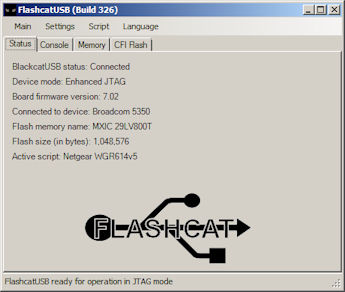
Blackcat USB SPI Flash Programmer ST SPANSION MXIC AMD


BlackcatUSB a multi-protocol flash memory programming tool

Capable of programming thousands of flash memory devices using JTAG or SPI connections.

This eBay item includes: a new BlackcatUSB board, USB cable, and a jumper cable of your choice.

Features:
  • Open-source software supports multi-languages: English, French, German, Portuguese, Spanish
  • Fast 16MHz RISC processor
  • 32KB Flash (upgraded from 16KB!)
  • 2 DIP switches for mode application changes
  • Upgradeable firmware over USB
  • On board reset button
  • Universal CFI Flash programming support (over JTAG)
  • SPI Mode 0, 1, 2 compatible
  • USB 1.1 / 2.0 compatible
  • Dual voltage (3.3v or 5v) output
This product includes a choice of these three cables for your target device:


This device can be used to program the flash memory of thousands of different memory devices, including the BIOS chips often used on many newer motherboards for both PC and laptops. It can be used on millions of devices to fix broken devices due to bad or corrupted firmware.

MSI Eclipse Motherboard
MSI P6NGM Motherboard
MSI P6NSLI Motherboard

Easy to use Microsoft Windows based software:


Reading flash data using JTAG mode


Writing flash data using SPI mode

FREE Open-source software compatible with:
Windows 2000, 2003, XP, Vista and Windows 7 (32-bit and 64-bit versions)
Mutli-language support: English, French, German, Portuguese, and Spanish,
(Download software and driver, version 330)


Verified to work with these CFI Flash devices:
AMD S29GL320 Intel  28F128J3 Samsung  K8D3216UB MXIC  29LV800BMC AMD 28F400BT Intel  28F160B3 Samsung  K8D3216UT SHARP  28F320BJE AMD 29DL322GB Intel  28F160B3 ST M28W160CB SHARP  LH28F160BJHG AMD 29DL322GT Intel  28F160C3B ST M29D323DB SHARP  28F160S3 AMD 29DL323GB Intel  28F160C3T FUJITSU  29DL323GB SHARP  28F320S3 AMD 29DL323GT Intel  28F320B3 FUJITSU  29DL323TE Microchip  SST 39VF1600 AMD 29DL324GB Intel  28F320B3 FUJITSU  29LV160B Microchip  SST 39VF1601 AMD 29DL324GT Intel  28F320C3 FUJITSU  29LV160T Microchip  SST 39VF3201 AMD 29LV160DB Intel  28F320C3 FUJITSU  29LV320BE Microchip  SST 39VF800 AMD 29LV160DT Intel  28F320J3 FUJITSU  29LV320TE ST / Micron  MT28W320 AMD 29LV320DB Intel  28F320J5 FUJITSU  29LV800B ST / Micron  MT28W320 AMD 29LV320DT Intel  28F640B3 Micron  28F160C34B ST / Micron  29W320DB AMD 29LV320MB Intel  28F640B3 Micron  28F160C34T ST / Micron  29W320DT AMD 29LV320MT Intel  28F640C3 Micron  28F322P3 ST / Micron  M29W160EB AMD 29LV400BB Intel  28F640C3 MXIC  25FL0165A ST / Micron  M29W160ET AMD 29LV800BB Intel  28F640J3 MXIC  29LV161B ST / Micron  M58LW064D Spansion  29AL016M Intel  28F640J5 MXIC  29LV161T ST / Micron  M29W800AB ATMEL  AT49BV/LV16X Intel  28F800B3 MXIC  29LV320B TOSHIBA  TC58FVT160B ATMEL  AT49BV/LV16XT Intel  28F800C3 MXIC  29LV320B TOSHIBA  TC58FVB321 HYHYNIX  HY29F400TT Samsung  K8D1716UB MXIC  29LV320T TOSHIBA  TC58FVT160 HYHYNIX  HY29LV1600T Samsung  K8D1716UT MXIC  29LV320T TOSHIBA  TC58FVT321
Verified to work with these SPI Flash devices:
Atmel  AT25DF641 Microchip  SST 25WF040 ST / Micron  M25P64 MXIC  MX25L128 Atmel  AT25DF321 Microchip  SST 25WF040B ST / Micron  M25P32 MXIC  MX25L256 Atmel  AT25DF161 Microchip  SST 25WF080 ST / Micron  M25P16 EON EN25F20 Atmel  AT25DF081 Microchip  SST 25WF080B ST / Micron  M25P80 EON EN25F40 Atmel  AT25DF021 Microchip  SST 25WF016 ST / Micron  M25P40 EON EN25F80 Atmel  AT26DF081A Microchip  SST 25WF016B ST / Micron  M25P20 EON EN25F16 Atmel  AT26DF161 Microchip  SST 25WF032 ST / Micron  M25P10 EON EN25F32 Atmel  AT26DF161A Microchip  SST 25WF032B Windbond  W25X40 EON EN25F64 Atmel  AT26DF321 Microchip  SST 25WF064 Windbond  W25X80 PMC  PM25LV010 Atmel  AT45DB011 Microchip  SST 25WF064B Windbond  W25X16 PMC  PM25LV020 Atmel  AT45DB021 Microchip  SST 25WF128B Windbond  W25X32 PMC  PM25LV040 Atmel  AT45DB041 Spansion  S25FL256S Windbond  W25X64 PMC  PM25LV080B Atmel  AT45DB081 Spansion  S25FL128S Windbond  W25Q80BV PMC  PM25LV016B Atmel  AT45DB161 Spansion  S25FL128P Windbond  W25Q16BV PCT 25VF512A Atmel  AT45DB321 Spansion  S25FL064 Windbond  W25Q32BV PCT 25VF010A Atmel  AT45DB642 Spansion  S25FL032 Windbond  W25Q64BV PCT 25VF020B Atmel  AT45DB011D Spansion  S25FL016 MXIC MX25L10 PCT 25VF040B Atmel  AT45DB021D Spansion  S25FL008 MXIC MX25L20 PCT 25VF080B Atmel  AT45DB041D ST / Micron  N25Q00A MXIC MX25L40 PCT 25VF016B Atmel  AT45DB081D ST / Micron  N25Q512 MXIC MX25L80 PCT 25VF032B Atmel  AT45DB161D ST / Micron  N25Q256 MXIC  MX25L160 PCT 25VF064C Atmel  AT45DB321D ST / Micron  N25Q128 MXIC  MX25L320 PCT 26VF016 Atmel  AT45DB642D ST / Micron  M25P128 MXIC  MX25L640 PCT 26VF032 ST / Micron  N25Q064
Verified MCU specific devices supported:
Nordic nRF24LE1 (16KB  flash over SPI) Xilinx CoolRunner-II  series (XC2C32A, XC2C64A, XC2C128, XC2C256, XC2C384, XC2C512)

If you need to program a flash here that is not listed, just contact us and request to have it added. We are able to add any SPI or CFI compatible flash to our software free of charge. If you need a specific MCU supported (such as a device with on board memory that can be programmed via SPI or JTAG), contact us!


New feature: manual configure for SPI devices

Rizal’s Settlement Project in Sabah

Image: Dr. Jose Rizal and Maria Clara (back-to-back, Rizal Park, Dumaguete City, Negros Oriental)
“If it is impossible for me to give my country liberty. I should like to give it at least to these noble countrymen of mine in other lands”.

On his trip to Hong Kong, Rizal by chance met an Englishman Mr. W.B. Pryor and his wife, who were on their way to Sabah (North Borneo) to whom Rizal had shared his idea of a Filipino settlement in Sabah.

The owner of the territory, the Sultan of Jolo, had it leased to the North Borneo Company in 1878 and was duly recognized by Spain, Germany and England with the condition that Spanish sovereignty over the island of Jolo will be honored.

What was in the mind of Rizal that he desired to establish Filipino community in Sabah? He said in his letter to Blumentritt on February 23, 1892: “if it is impossible for me to give my country liberty.

I should like to give it at least to these noble countrymen of mine in other lands”. Based on this statement, we can conclude that Rizal was apparently considering of relocating his family in Sabah where he can organize a Filipino community who would devote themselves in agriculture, he serving as the leader. He observed in Hong Kong that Englishmen governed their colony well far from the persecutions suffered by the natives of Philippines from the Spaniards.

Text via National Historical Commission of the Philippines: Rizal’s Settlement Project in Sabah
by Quennie Ann J. Palafox